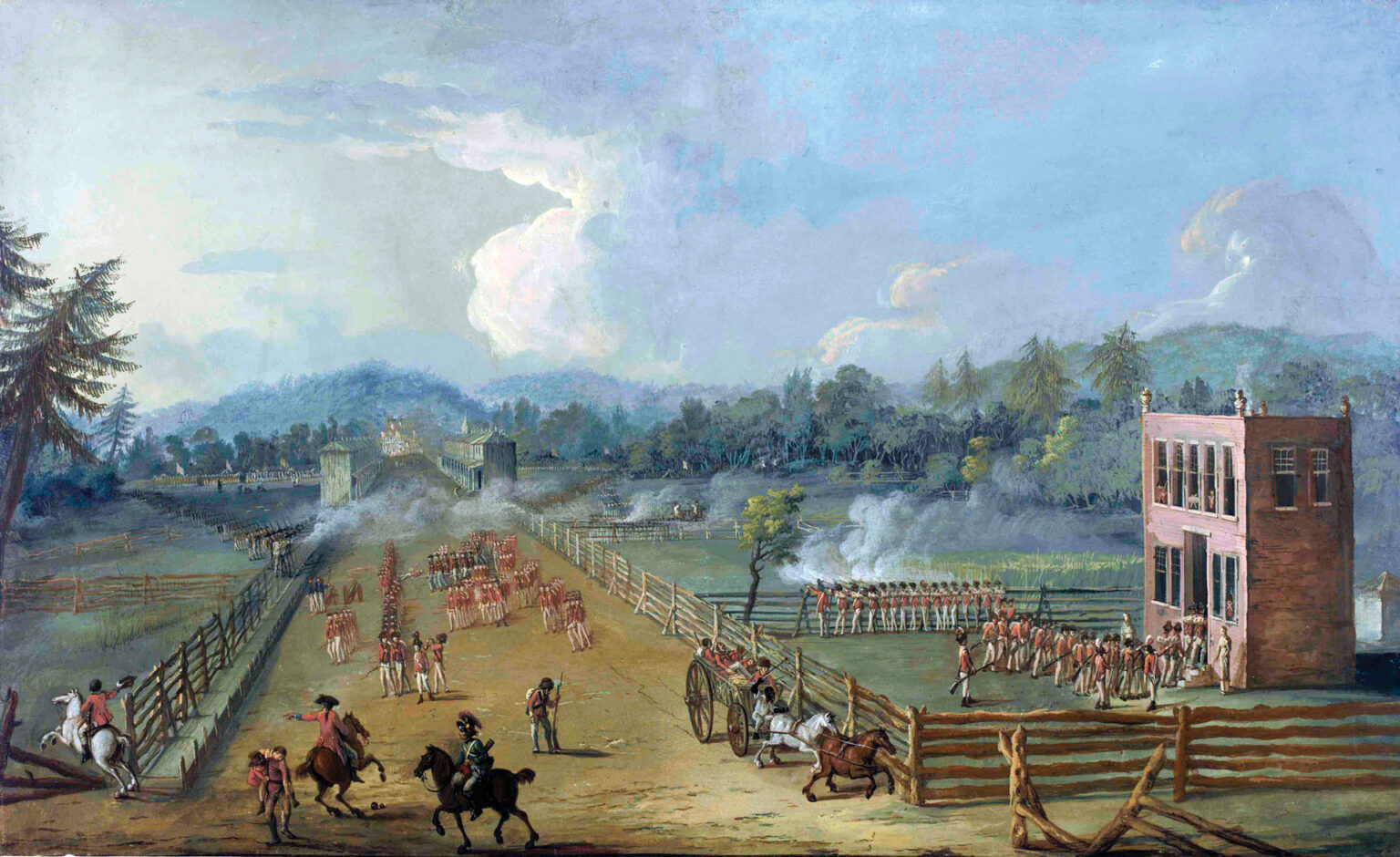

A History of the 15th Regiment During the American War of Independence
This history of the 15th Regiment comes from the "Historical Record of the Fifteenth, or, the Yorkshire East Riding Regiment of Foot, Containing an Account of of the Formation of the Regiment in 1685 and of its Subsequent Services to 1848" written by Richard Cannon, Esq
The determined spirit evinced by the British colonists in North America to resist the acts of parliament passed in England for raising a revenue in their country, had been followed by hostilities, and theFifteenth regiment was one of the corps selected to
[47]
proceed across the Atlantic, to aid in the attempt to reduce the refractory provincials to submission. The regiment embarked from Ireland early in 1776, and proceeded to Cape Fear, in North Carolina, with four other corps, under Major-General the Earl Cornwallis. These troops arrived on the coast of North Carolina early in April, and Lieut.-General Clinton assumed the command. The men landed at Cape Fear to refresh themselves after the voyage, and returning on board the transports, sailed, on the 1st of June, with the expedition against Charleston. After passing Charleston bar, the troops landed on one of the islands, but the armament proved of insufficient strength for the capture of the capital of South Carolina, and the five regiments re-embarked and proceeded to Staten Island, where the main body of the British forces was assembled under General Sir William Howe. The Fifteenth, commanded by Lieut.-Colonel John Bird, were formed in brigade with the fourth, twenty-seventh, and forty-fifth regiments, under Major-General Pigot.
A landing was effected on Long Island on the 22nd of August, and the Fifteenth regiment formed part of the force under Lieut.-General Clinton, which advanced after dusk on the evening of the 26th to seize on a pass in the heights, and turn the enemy's left flank at Flat-bush. This pass was taken possession of on the following morning; the army advanced, and the Americans were driven from their position with considerable loss, and forced to retreat to their fortified lines at Brooklyn. The loss of the regiment on this occasion was limited to a few men wounded.
The Americans quitted their fortified lines during the night of the 28th of August, and retired across the East River, in boats, to New York; and the reduction
[48]
of Long Island was thus accomplished in a few days, with little loss.
From Long Island the regiment proceeded with the army across the East River, when General Washington was forced to abandon New York, which city was taken possession of by the British.
Proceeding up the river, the regiment took part in the operations of the army by which the Americans were forced to evacuate their lines on White Plains; but it did not sustain any loss.
The regiment took part in the attack and capture of the enemy's lines and redoubts near Fort Washington, on the 16th of November, when it had a few private soldiers killed and wounded.
After taking part in these services, the regiment proceeded into winter quarters at the city of New York.
1777
Information being received that the Americans were forming magazines at Peek's-hill, about fifty miles up the North River, Lieut.-Colonel Bird, of the Fifteenth, was detached from New York against that post, with a body of troops, of which a division of the regiment formed part. The troops sailed from New York on the 22nd of March, 1777, and as they approached Peek's-hill, the Americans set fire to the stores and retreated. The British landed, completed the destruction of the magazines, barracks, &c., and afterwards returned to New York.
Extensive depôts were also prepared by the Americans at Danbury, and other places on the borders of Connecticut, and the Fifteenth regiment formed part of a body of troops which embarked from New York, under Major-General Tyron, for the destruction of these magazines. The British arrived off Norwalk
[49]
on the evening of the 25th of April, landed without opposition, and commenced their march for Danbury, from whence the American troops fled, as the English approached that place on the afternoon of the following day. As no carriages could be procured to bring off any part of the immense collection of stores at this place, the magazines were set on fire, and in the progress of the flames the town was unavoidably burnt. This service accomplished, the British commenced their march back to the coast, early on the morning of the 27th of April, when a body of Americans hung upon their rear, and at every eminence a corps of militia was found ready to oppose their march; but they attacked and routed their opponents; and in one of the skirmishes the American General Wooster was killed.
Arriving at Ridgefield, the British were opposed by a strong force under General Arnold, protected by intrenchments, which the Americans were preparing; but a few rounds from the English artillery, and a gallant charge with bayonets, routed the American force, and the King's troops halted at Ridgefield during the night.
Resuming the march on the following morning, the British were harassed by the enemy, in their retrograde movement, and numerous skirmishes occurred. Arriving at the Hill of Compo, contiguous to the place of embarkation, the Americans appeared in force, and commenced an attack with greater spirit and determination than before; the British troops confronted their numerous assailants, fired a volley, and charged with bayonets with so much impetuosity and valour, that the Americans were unable to withstand the shock, and they retreated. The King's troops afterwards embarked without molestation for New York.
[50]
Eight rank and file of the Fifteenth regiment were killed on this expedition; Captain Harry Ditmas, one serjeant, and fifteen rank and file wounded; two men missing. Lieutenant Charles Hastings, of the twelfth foot, serving as a volunteer with the regiment, was also wounded.
Afterwards taking the field with the army in the Jerseys, the regiment was engaged in the operations designed to bring the enemy to a general engagement, but the Americans kept close in their fortified lines in the mountains; and an expedition against the populous and wealthy city of Philadelphia was resolved upon. The Fifteenth, commanded by Lieut.-Colonel John Bird, were employed in this enterprise, and were formed in brigade with the seventeenth, forty-second, and forty-fourth regiments, under Major-General (afterwards Earl) Grey.
Embarking from Sandy Hook, the army sailed to the Chesapeake, and proceeding up Elk River, landed on the northern shore on the 25th of August. The American army took up a position at Brandywine to oppose the advance, and on the 11th of September the royal forces moved forward to engage their opponents. The Fifteenth formed part of the column under Major-General the Earl Cornwallis, which made a circuit of some miles to turn the right and gain the rear of the American army. The action proved decisive; the enemy was driven from his position, and forced to make a precipitate retreat. The battalion companies of the regiment did not sustain any loss on this occasion; but the flank companies, being formed in grenadier and light infantry battalions, had Lieutenant Faulkener killed; Captain Cathcart, Captain Douglas, and Lieutenant Leigh wounded; also several men killed and wounded.
[51]
After this victory, the army continued its advance; Philadelphia was taken possession of, and the British troops took up a position at Germantown, the Fifteenth being posted on the left of the village.
Making a forced march during the night of the 3rd of October, the American army appeared suddenly in front of Germantown before daylight on the following morning, and attacked the British outposts, thinking to surprise the troops in an unprepared state. The first assault was opposed by the second battalion of light infantry, and the fortieth regiment, under Lieut.-Colonel Musgrave, posted at the head of the village; these corps were forced to fall back, and Lieut.-Colonel Musgrave threw himself, with six companies of the fortieth, into a large store-house, where he was attacked by an American brigade, aided by four pieces of cannon. During the contest, while the soldiers of the fortieth were defending their post manfully, Major-General Grey brought forward the Fifteenth, and two other corps; and making a determined attack on the American regiments, drove them back with great slaughter. The enemy was also repulsed at every part of the field, and forced to make a precipitate retreat.
Lieut.-Colonel John Bird, Ensign Anthony Frederick, and five rank and file of the regiment were killed; Captains George Goldfrap and Harry Ditmas, Lieutenant George Thomas, Ensign Henry Ball, two serjeants, and forty-two rank and file wounded. In alluding to the death of Lieut.-Colonel Bird, General Sir William Howe spoke of it as an event 'much to be lamented, he being an officer of experience and approved merit.' General Washington formed a fortified camp at Whitemarsh; and early in December the British army advanced with the view of inducing the
[52]
Americans to quit their lines and offer battle, or of finding a vulnerable part in their fortified camp. Several skirmishes occurred, in which the British troops evinced their native intrepidity and firmness, and were victorious in every instance; but the defences of the American camp were found too strong to be attacked, and the army marched into winter quarters at Philadelphia.
1778
After passing the winter at the capital of Pennsylvania, the regiment furnished several parties, in the spring of 1778, to range the country, and open communications for bringing in supplies.
The regiment also shared in the fatigues and difficulties of the march of the army from Philadelphia to New York, under Lieut.-General Sir Henry Clinton, rendered necessary by the French monarch having united with the revolted British provinces, and thus changed the character of the war. As the army pursued its journey, crossing rivers, and traversing a wild and woody country, the enemy menaced the flanks and rear with an attack in force; and on the 28th of June, some sharp fighting took place, near Freehold in New Jersey, when the grenadier company of the Fifteenthdistinguished itself, and the enemy was repulsed. Captain Cathcart, of the regiment, was wounded; and also Captain Ditmas, who was attached to the second grenadier battalion.
The army afterwards continued its route, and arrived at New York in July.
A powerful French armament menacing the British possessions in the West Indies, the Fifteenth, and several other corps, sailed from North America, early in November, for Barbadoes, under Major-General Grant.
[53]
While the regiment was at sea, its colonel, Major-General the Earl of Cavan, died at Dublin, and was succeeded by Major-General William Fawcett, deputy adjutant-general to the forces.
On the arrival of the reinforcements at Barbadoes, the British naval and military commanders resolved to act offensively, and attack the French island of St. Lucia. On this occasion the regiment was formed in brigade with the twenty-eighth, forty-sixth, and fifty-fifth, under Major-General Prescott. The expedition sailed from Carlisle-bay on the 12th of December, a landing was effected at St. Lucia on the following day, and on the 14th, the French troops were driven from several important posts. In the meantime a French armament of very superior numbers approached the island, and the British took up positions to repel the enemy. The French fleet made a desperate attack on the British naval force, but was repulsed. A numerous body of the enemy landed, and stormed the post of La Vigie, which was occupied by the grenadiers, light infantry, and fifth regiment, under Brigadier-General Medows; when the determined bravery of the British proved triumphant over very superior numbers, and the French were repulsed and forced to re-embark, leaving the ground covered with killed and wounded. The flank companies of the Fifteenth had an opportunity of distinguishing themselves on this occasion. The governor surrendered the island to the British arms immediately after the departure of the French armament.
1779
1780
The Fifteenth remained at St. Lucia several months. In the meantime, the French possessed a great superiority of numbers, both of naval and land force, in the West Indies; and in June, 1779, they
[54]
attacked the island of St. Vincent, and in July Grenada; the regiment embarked from St. Lucia, for the relief of these islands; but they were captured before any force could arrive to their assistance. While the regiment was at sea, some sharp fighting occurred between the hostile fleets, without decisive results, and the regiment was afterwards landed at the island of St. Christopher's, where it was stationed during the year 1780.
1781
Holland having adopted a line of politics hostile to the British, and favourable to the American interest, war took place between Great Britain and the United Provinces; and in February, 1781, the Dutch island of St. Eustatius was captured. The Fifteenth regiment was afterwards removed from St. Christopher's to St. Eustatius, and the flank companies were subsequently detached to the former island.
The British commandant at St. Eustatius neglected to adopt the necessary precautions for the security of the island, and during the night of the 26th of November, a French force, under the Marquis of Bouillé, effected a landing, captured the commandant as he was taking a morning ride, overpowered the posts, and forced the garrison, consisting of the battalion companies of the thirteenth and Fifteenth regiments, to surrender prisoners of war. The commandant, Lieut.-Colonel Cockburn, was afterwards tried by a general court-martial, and cashiered.
After being detained a short period, the regiment was exchanged, and resumed its duties.
1782
The flank companies were stationed at St. Christopher's, with the first battalion of the royals and a detachment of artillery, which constituted the military force of the island, under Brigadier-General Fraser, when a powerful French armament appeared off that
[55]
place in the beginning of January, 1782. Eight thousand French troops landed, with a powerful train of artillery, under the Marquis of Bouillé; and the English troops, being unable to oppose so numerous a host on open ground, took possession of Brimstone-hill, a formidable post, but the fortifications were old and in a ruinous state, and the soldiers had no intrenching tools; a desperate defence was however determined on, in hopes of being relieved.
Against this post the French batteries opened their fire, on the 19th of January, and from that day a storm of balls and bombs rattled round the hill with increasing fury, until the houses on the heights were battered to pieces, and the old works were nearly destroyed. During this period a British naval force approached the island, and a body of troops landed; but the enemy had so great a superiority of numbers, that no reasonable expectation could be entertained of being able to save the island, and the troops returned on board the fleet. In the meantime, the works on Brimstone-hill had been breached in several places, and the garrison was reduced to the last extremity; yet the troops continued to evince that valour and firmness for which British soldiers have been distinguished; and their conduct excited the admiration of their enemies. When all prospect of being able to resist many hours longer was gone, the garrison capitulated, and was permitted to march through the breach with the honours of war, and return to England, on condition of being considered as prisoners of war until exchanged. The conduct of the officers and soldiers who defended Brimstone-hill was highly commended in Brigadier-General Fraser's despatch; and has been held up as an example of British courage and resolution, by historians.
[56]
The regiment returned to England, and many of the officers and men, who had been made prisoners, were lost on the voyage, in the Ville de Paris, a French ship, which had been captured by Admiral Rodney.
This year the Fifteenth received the title of the East Riding Yorkshireregiment, and was directed to cultivate a connexion with that part of the county, to facilitate the procuring of recruits.